
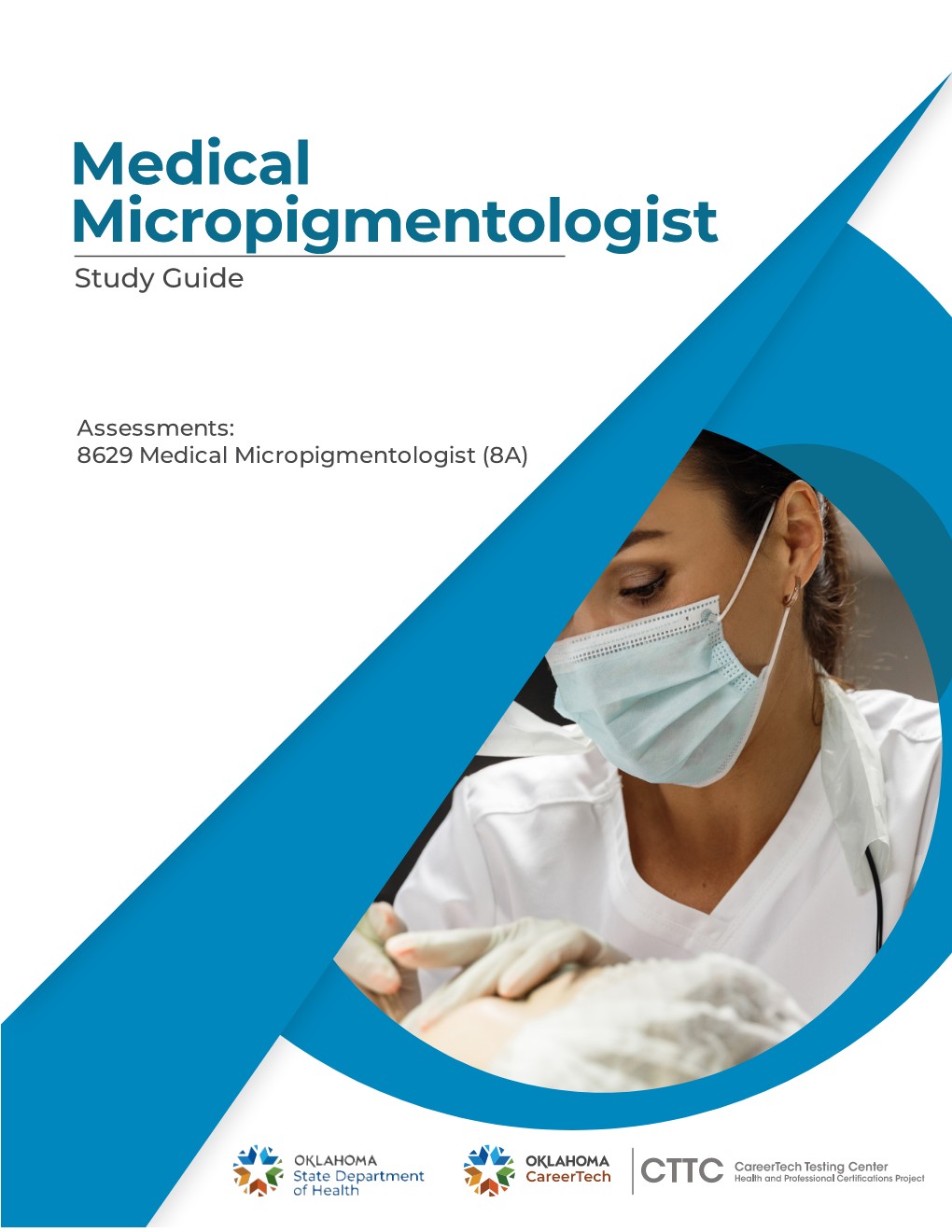
Oklahoma’s publicly accessible examination blueprint offers the permanent makeup industry a useful benchmark for defining practitioner knowledge. It also invites a broader discussion: what evidence should establish that a practitioner can deliver safe, consistent work?
The development should be described carefully. The Oklahoma State Department of Health resources page links an official Medical Micropigmentologist Exam Study Guide, but the guide has no publication or revision date. Its availability is newly verified information, rather than proof of a newly adopted examination or licensing change.
What the blueprint establishes
The guide describes 65 written questions, a two-hour limit and a 70% passing score. Results are immediate. Candidates need OSDH authorization, including a new agency letter for retesting.
| Examination domain | Weight |
| Client consultation | 26% |
| Performing procedures | 17% |
| PMU theory and application | 15% |
| Safety and aseptic technique | 11% |
| Anatomy physiology and disease | 11% |
| Color theory | 11% |
| Professionalism | 9% |
These weights describe written examination coverage. The procedures category does not, by itself, establish an observed practical examination.
Practical assessment already exists in the wider framework
Reading the guide alone would leave an incomplete picture. Oklahoma’s posted Chapter 234 rules require approved training with theory and clinical instruction, skills evaluations and a written certification examination. Technique mastery requires demonstrating all skills on the relevant job sheets to the instructor with 100% accuracy. The rules also specify an 85% threshold for applicable theory tests during training, separate from the final written examination’s 70% threshold.
Accordingly, the question is how consistently practical competence is measured across training programs—and how clearly the public can understand that process. The published guide does not describe an independent practical examination rubric or healed-work assessment.
The benefits for the PMU industry
A visible blueprint gives educators and candidates a common reference. It can help schools explain how their instruction prepares candidates for assessment and help practitioners identify gaps in their preparation.
Its substantial consultation weighting also offers a useful professional message: assessment should address judgment before treatment, alongside technical knowledge. For the industry, a meaningful competency standard should reward recognizing when to defer a procedure as well as knowing how to perform it.
Oklahoma’s combination of instructor-assessed skills and a written examination provides a structure that other competency initiatives can study. It offers a starting point for comparing learning requirements, rather than relying solely on course titles or completion certificates.
The limitations and tradeoffs
A written score cannot directly show needle control, tissue handling or maintenance of aseptic technique during an actual procedure. Equally, an instructor’s sign-off becomes more useful to outside reviewers when the scoring criteria, evidence requirements and quality checks are visible.
Training-provider assessment may offer accessible, continuous feedback. However, when the same organization teaches and assesses a candidate, independent moderation could strengthen confidence in the result. This is a governance consideration, not evidence that Oklahoma instructors assess candidates improperly.
The guide lists technical publications from 1993, 1999 and 2001. Their age warrants a documented currency review; age alone does not establish that their content is incorrect. The guide also does not explain its passing-standard methodology or provide a revision history.
Additional assessment can introduce expense, scheduling delays and evaluator bias. Stronger standards should therefore be piloted for reliability and access before becoming additional barriers to entry.
How the framework could develop
A more transparent competency model could publish the following criteria:
| Capability | Proposed evidence |
| Client judgment | Scored consultation scenarios covering consent, suitability, deferral and referral |
| Safe technique | Observed setup, contamination prevention, sharps handling and response to a safety breach |
| Procedure execution | Procedure-specific assessment of planning, equipment use, control and tissue response |
| Results and follow-up | Authenticated case records and standardized healed photographs, with client consent |
| Professional accountability | Complete records, pigment traceability, aftercare and escalation decisions |
These are proposed improvements, not newly announced Oklahoma requirements.
Evaluators should use shared scoring examples and periodically score the same sample work to check agreement. Defined critical safety failures should require remediation regardless of an otherwise strong overall result. Healed-work reviews should account for client variability and follow-up limitations.
The examination owner should publish version dates, reference-review schedules and the rationale for passing standards, while protecting examination security. Appeals, accommodations and reassessment routes should be clear. The existing guide already addresses testing accommodations; further development should build on that provision.
What this means for independent certification
For initiatives such as Permanent Glow’s proposed competency authority, Oklahoma offers a benchmark to compare against and develop further. A credible program could map its knowledge domains to this blueprint, then publish how it verifies practical performance, calibrates evaluators and reviews outcomes.
Independent certification would supplement applicable state requirements; it would not grant legal authority to practice.
Oklahoma’s example moves the discussion toward a more useful question for clients and the profession: what documented evidence supports a practitioner’s claimed capabilities, and how is that evidence assessed consistently?
Sources
1. OSDH Consumer Health Resources
2. Official Medical Micropigmentologist Exam Study Guide
3. OSDH posted Chapter 234 Medical Micropigmentation rules, particularly 310:234-3-3 and 310:234-3-4. The posted compilation identifies its rule-text retrieval date as September 30, 2024.
Source review November 7, 2026. This article addresses the published assessment framework; it does not attribute a new policy decision to the November 6 advisory council meeting.
© 2026 Permanent Glow. All rights reserved. This publication may be quoted in limited excerpts with clear attribution. Reproduction, republication, commercial adaptation, distribution, or use in developing a competing commercial program without written permission is prohibited.
