
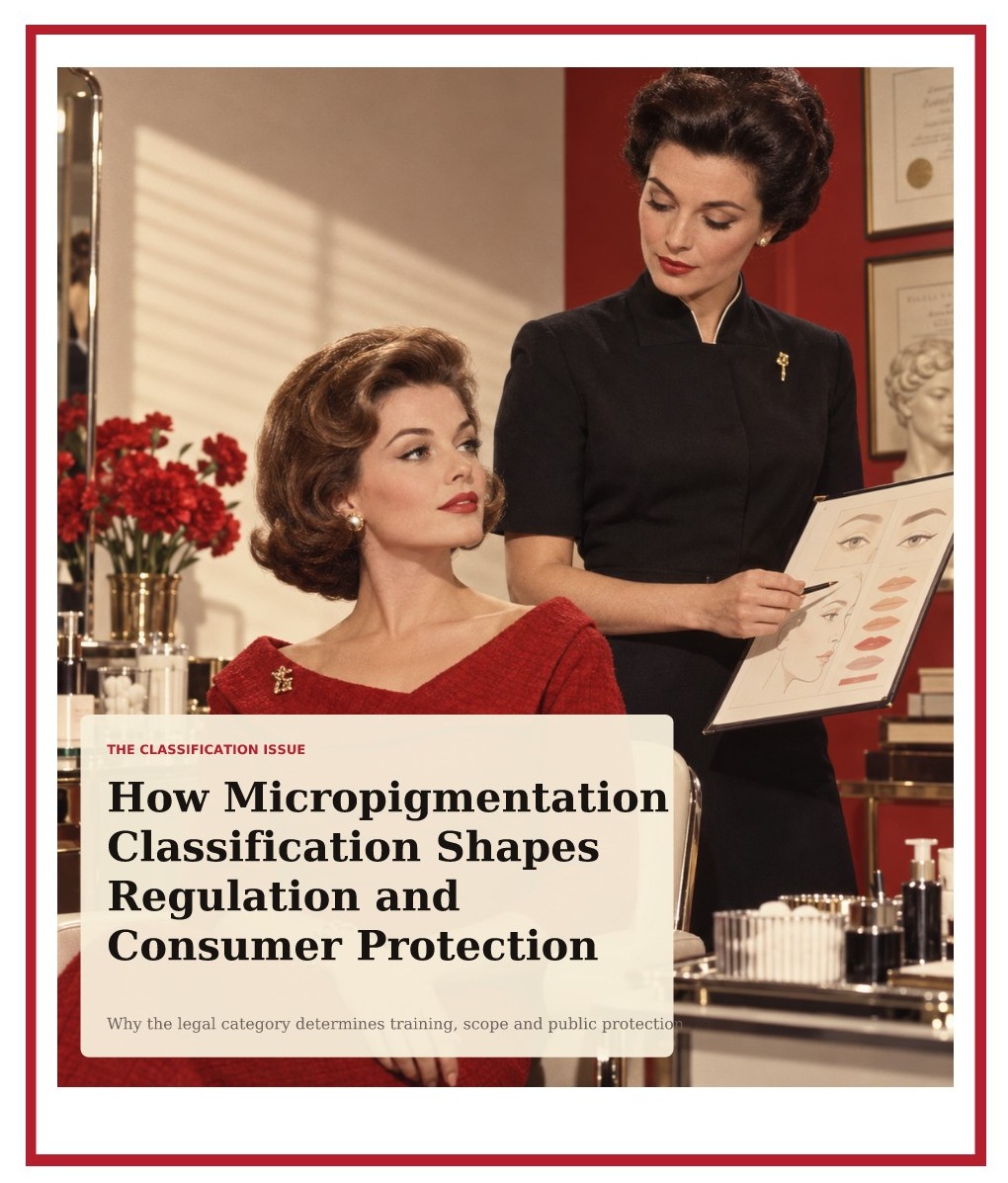
GOVERNANCE
Classification
Why the legal category determines training, scope and public protection
Classification Is More Than Terminology
The category assigned by law determines authority, education, examinations, facilities and the limits of practice.
THE CLASSIFICATION of micropigmentation is more than a question of terminology. The category assigned by law determines which agency has authority, what training counts, whether an examination is required, where services may be performed, how facilities are inspected and which procedures fall outside a practitioner’s permitted scope.
Current law does not supply one national answer. Federal regulators focus primarily on inks and pigments, while states and local jurisdictions regulate the act of placing pigment into skin. The U.S. Food and Drug Administration treats inks used in intradermal tattoos, including permanent makeup, as cosmetics. The FDA also states that the actual practice of tattooing is regulated by local jurisdictions.
That division leaves states to decide whether permanent makeup belongs inside tattooing, cosmetology, body art, health care or a separate occupational category. A useful classification system should preserve the health protections shared by all skin-penetrating procedures while defining the competencies specific to micropigmentation.
“Shared mechanism does not mean identical occupation.”
WHY BODY ART BECAME THE DEFAULT
A common risk created a common regulatory home
Tattooing, permanent cosmetics and some restorative pigment procedures use needles or similar instruments to breach the skin and deposit color. They therefore share core concerns involving bloodborne pathogens, cross-contamination, contaminated ink, sharps handling, client records, aftercare and adverse reactions. The FDA has documented infections and recalls involving contaminated inks and notes that no color additives are approved for injection into the skin.
From a public-health perspective, placing these practices under a common sanitation framework is understandable.
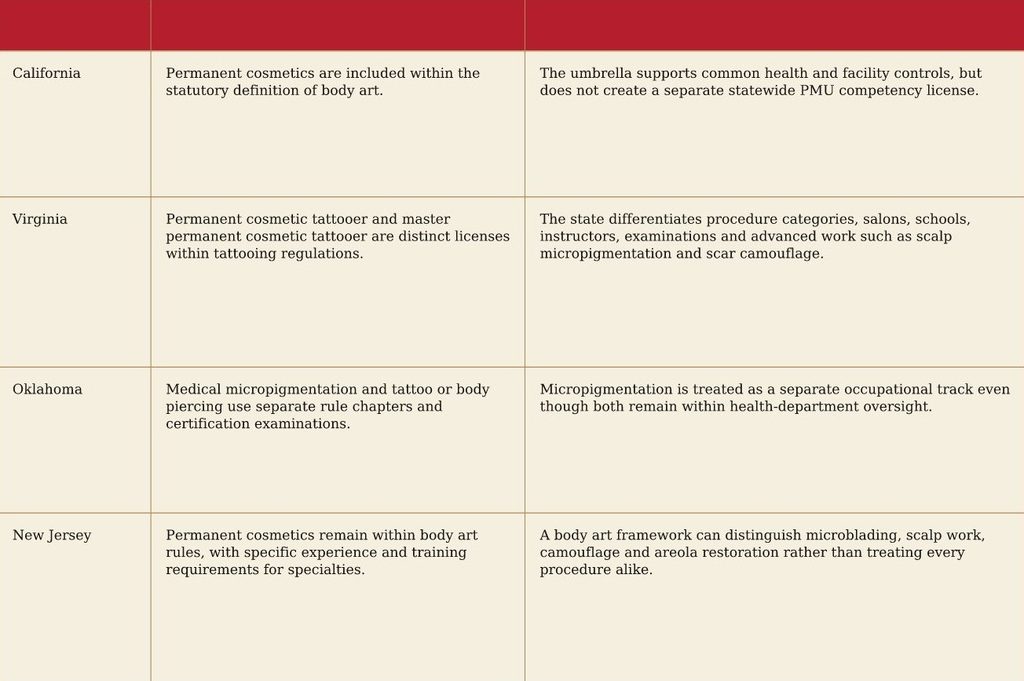
California’s Safe Body Art Act defines body art to include body piercing, tattooing, branding and permanent cosmetics. It separately defines permanent cosmetics as placing pigment in skin tissue to change color or appearance, including permanent eyeliner, eyebrows and lip color. Los Angeles County registers practitioners and permits facilities under that framework.
The weakness appears when a broad infection-control category becomes the only occupational classification.
Shared sanitation rules do not establish that illustrative tattooing, piercing, eyebrow micropigmentation, eyeliner, lip coloration, scalp micropigmentation, scar camouflage and areola restoration require identical education or demonstrate competence in the same way.
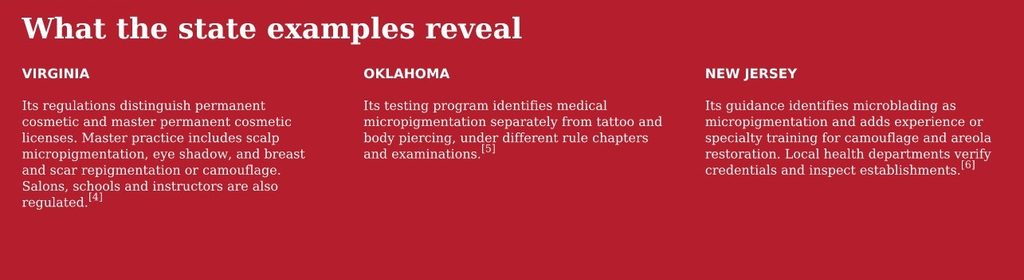
Four Models One Unsettled Question
Classification Determines What Competence Means
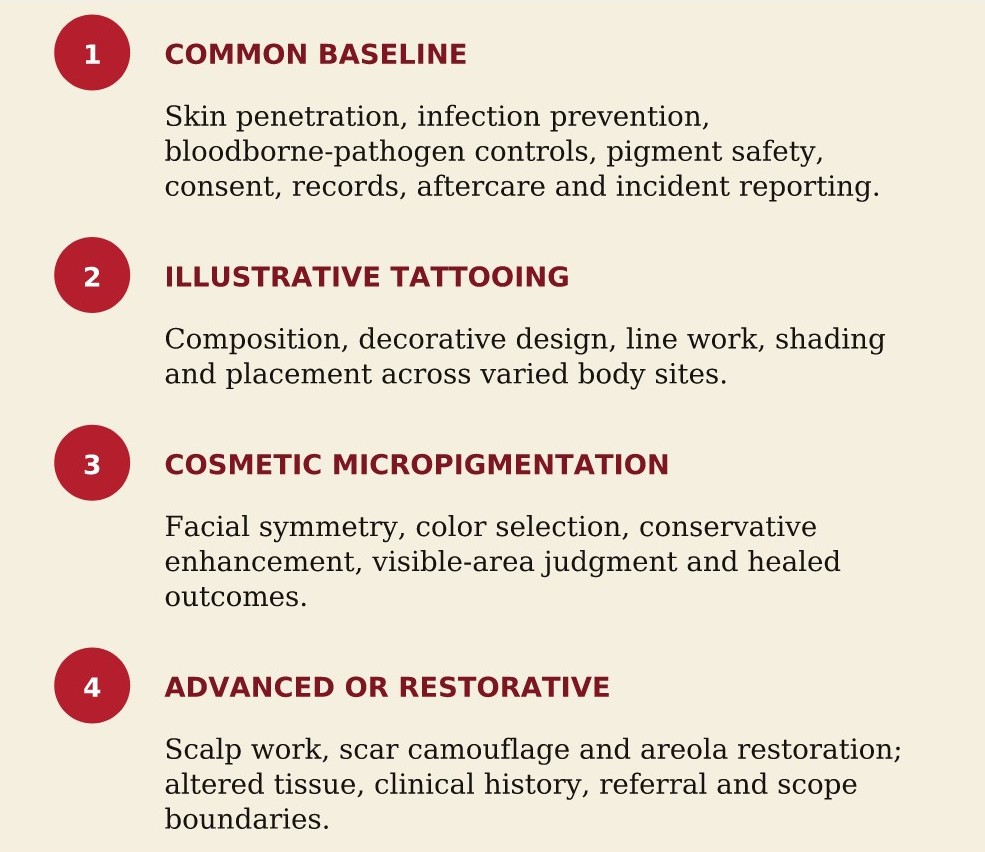
A legal category should do more than describe the tool entering the skin. It should help regulators identify the work
being performed and the competence needed to perform it. Illustrative tattooing commonly emphasizes composition, line
work, shading, placement across varied body sites and execution of decorative designs. Micropigmentation commonly emphasizes facial symmetry, controlled enhancement, color selection, conservative placement and management of results in highly visible areas. Restorative procedures add questions involving altered tissue, scarring, surgical history, clinical referral and boundaries between cosmetic and medical practice. These distinctions should not minimize risk. Permanent makeup remains an invasive pigment-implantation procedure. The argument for a clearer category is that its risks and competencies should be defined accurately—not that ordinary health protections should be removed.
THE ISO CONNECTION
A certification scheme must first define the occupation
ISO/IEC 17024:2026 describes certification of persons as assurance that an individual meets defined competence
requirements within a specific certification scheme. A certification body cannot build a defensible scheme until it defines the occupation, its permissible tasks and the competence being assessed. If micropigmentation is defined only as generic body art, examinations and eligibility rules may measure shared sanitation knowledge while overlooking procedure-specific judgment and performance.
PROCEDURE PROFILE
Shared risk distinct competence
“A stronger classification
is based on purpose,
procedure, treatment
area and scope—not on
the needle alone.”
A Neutral Classification Approach
A defined micropigmentation specialty can retain the health protections shared with tattooing.
A workable policy model could recognize micropigmentation as a defined specialty while retaining the public-health requirements shared with tattooing. Under that approach, classification would be based on purpose, procedure, treatment area and scope rather than on the needle alone.
THE BASELINE LAYER
Protections shared by all skin-penetrating practices
Infection prevention, bloodborne-pathogen controls, safe pigments and supplies, client consent, recordkeeping, aftercare, incident reporting and facility inspection.
THE SPECIALTY LAYER
Competence for permanent cosmetics and micropigmentation
Defined procedures within scope; procedure-specific education; supervised experience; evaluation of initial and healed outcomes; and independent evidence of readiness before unsupervised practice.
THE ADVANCED LAYER
Additional prerequisites and referral rules
Advanced or restorative procedures may require higher experience thresholds and explicit referral boundaries where treatment purpose or client history approaches medical practice.
WHO REGULATES WHAT
One framework does not require one agency
A state may regulate the practitioner through an occupational board while a county health department
permits and inspects the facility. Another state may keep both responsibilities within its health department.
The important point is that the legal documents identify who regulates the person, who regulates the premises, what
evidence establishes competence and where the practitioner must refer or decline a service.
QUESTIONS POLICYMAKERS SHOULD ANSWER
- Which procedures are included in general
micropigmentation, and which require an advanced
credential or medical referral? - Do training and examination requirements test the specific
procedures a practitioner intends to offer? - Are course completion and independent proof of
competence treated as different evidence? - Which agency regulates individual qualifications, and
which authority permits and inspects the facility? - How are microblading, machine work, scalp
micropigmentation, scar camouflage and areola
restoration classified? - Can consumers verify standing, authorized scope and
facility status through a public record?
© 2026 Permanent Glow. All rights reserved. This publication may be quoted in limited excerpts with clear attribution. Reproduction, republication, commercial adaptation, distribution, or use in developing a competing commercial program without written permission is prohibited.
