What a San Bernardino County records request revealed about the missing middle between public-health compliance, practitioner classification, and actual competency.
I called San Bernardino County expecting a list. I ended the call with a different question: What, exactly, does it mean when California says a body art practitioner is registered?
The request itself was straightforward. I have been trying to assemble a statewide picture of practitioners who perform permanent makeup and micropigmentation. I wanted to know who is registered, where they work, and how local jurisdictions distinguish permanent cosmetics from tattooing, piercing, branding, and other activities that California places under the broad label of body art.
The answer from San Bernardino County was revealing precisely because it was not hostile, evasive, or complicated. The County representative explained that the County could provide a list of registered body art practitioners — he said a recent list contained more than 800 names — but could not tell me which of those people specialized in permanent makeup. The database, he said, did not preserve that distinction in a way he could retrieve for me.
“I can give you a list of body practitioners, but I can’t tell you what their specialties are.”
THE FORM KNOWS MORE THAN THE LIST
That answer became more significant when compared with San Bernardino County’s own published practitioner application. The current Body Art Practitioner Packet does, in fact, ask the applicant to identify the activity being performed. The choices are explicit: Tattoo, Body Piercing, Permanent Cosmetics, Branding, or Body Art Training.
That creates an important distinction. The County appears to collect a practitioner’s activity classification at the application stage, yet the representative told me the County could not generate a permanent-cosmetics-only practitioner roster from its database. I cannot conclude from one phone call exactly how the County’s internal data architecture works. But as a public-records and governance question, the result is clear enough: information that exists on the intake form is not necessarily available as a usable specialty-specific public record.
For an industry trying to understand who is legally practicing micropigmentation, that is not a trivial data problem. If the system can tell us that a person is registered but cannot readily tell us what type of body art that person performs, the registration record answers only part of the public’s question.
WHAT REGISTRATION ACTUALLY PROVES
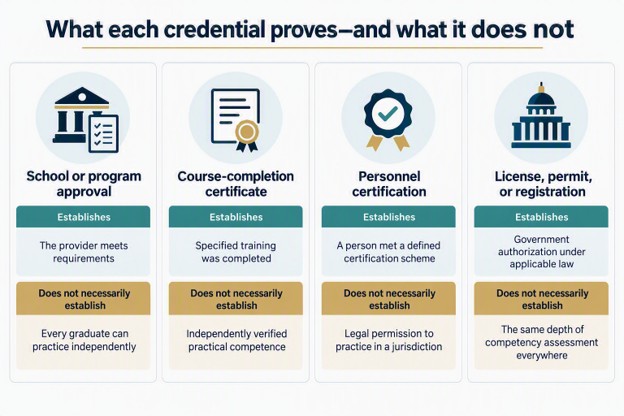
The call then moved from classification to competence. I asked what the County verifies about the practitioner. The representative was direct: the County verifies the paperwork required for an active registration. San Bernardino County’s published requirements support that description. A practitioner must submit an application and fee, evidence of body-art-specific bloodborne-pathogen training, proof satisfying the hepatitis B requirement, and valid photo identification for a first-time registration. The practitioner registration is renewed annually.
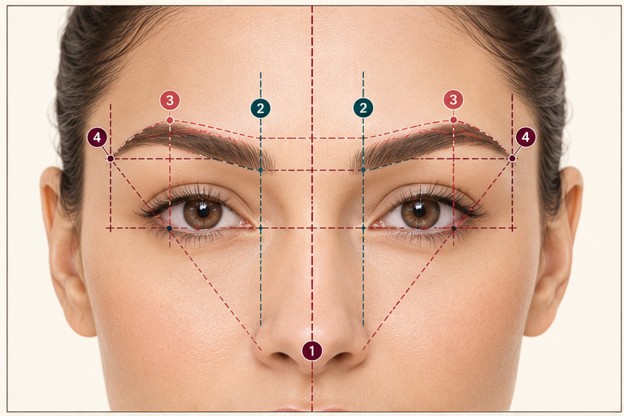
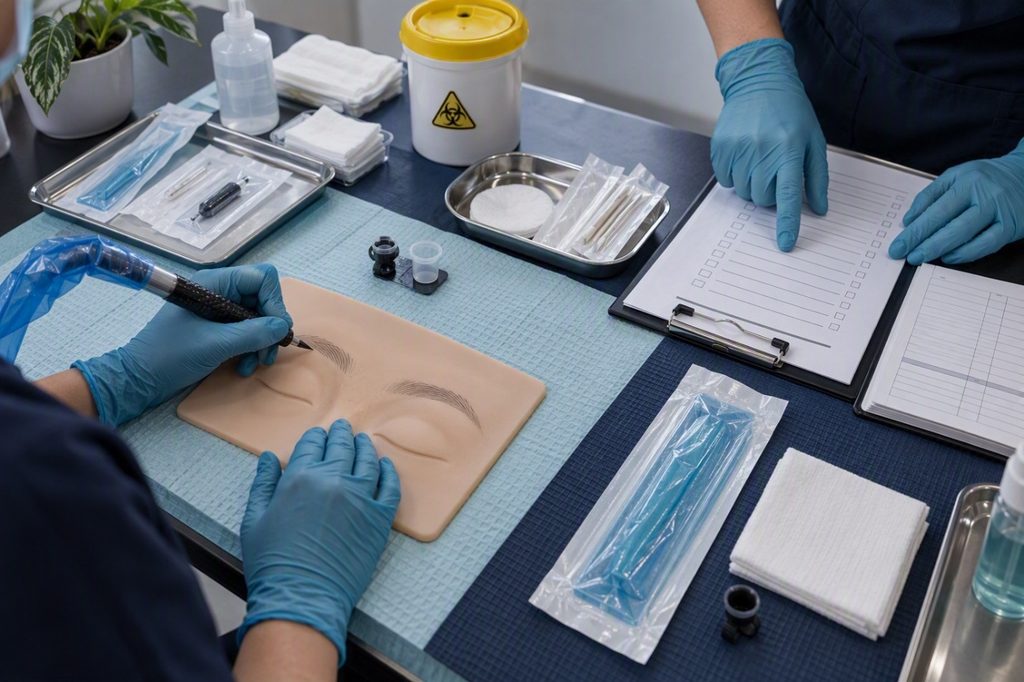
Those are meaningful public-health protections. Bloodborne-pathogen training, vaccination status, sanitation rules, sharps handling, facility conditions, infection-control procedures, and inspection all matter. They reduce the risk of disease transmission and cross-contamination. But they answer a different question from whether someone has demonstrated proficiency in eyebrow mapping, pigment selection, needle configuration, skin assessment, color correction, lip work, eyeliner placement, scalp micropigmentation, or the judgment required to stop a procedure when the result is going wrong.
In the conversation, the representative captured that boundary plainly: the County is not deciding ‘how good’ or ‘how bad’ a practitioner is. That statement should not be read simply as an admission of administrative failure. California’s Safe Body Art Act was designed primarily as a public-health law. Its statewide purpose is to establish minimum standards intended to protect practitioners and clients from infectious disease and cross-contamination. In other words, the County may be doing exactly what the law was designed to make it do — and that may be the deeper problem.
“The question may not be whether San Bernardino is failing to apply the law. The question may be whether the law is being asked to answer a competency question it was never built to answer.”
THE MISSING MIDDLE
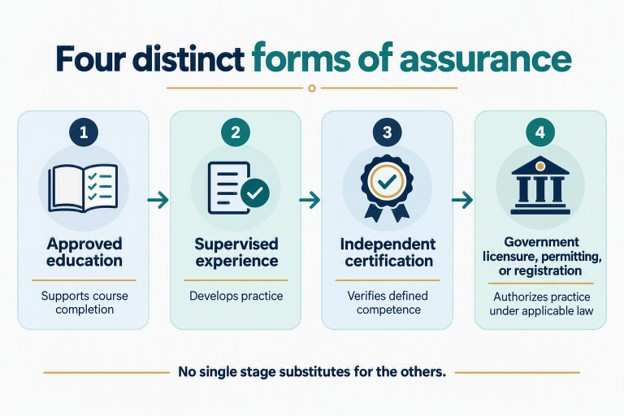
This is where the distinction between registration and certification becomes essential. Registration can tell the government who a person is, where that person works, whether required health-and-safety documentation is current, and whether the person is operating inside a permitted system. Certification or licensure based on competence asks something else: Has this individual demonstrated the knowledge and practical ability to perform a defined procedure to an accepted standard?
Those concepts should not be confused. A current bloodborne-pathogen certificate is evidence that someone completed required infection-control education. It is not evidence that the person can design a balanced brow, select an appropriate pigment for a client’s skin and undertone, recognize contraindications beyond the basic public-health checklist, execute consistent implantation, or manage a correction without compounding the original problem.
This is especially important in permanent cosmetics because the work is performed on the face and because an error can be both highly visible and difficult to reverse. The issue is not whether beauty can be judged objectively. Aesthetic preference will always contain subjectivity. Competence, however, can still be evaluated through objective components: sanitation, skin knowledge, color theory, contraindications, equipment handling, procedure planning, supervised case experience, healing knowledge, informed consent, complication recognition, documentation, and a demonstrated ability to execute core techniques safely and consistently.
THE FOUR RECORDS A MODERN SYSTEM SHOULD BE ABLE TO ANSWER
| 1 PLACE | Is the facility permitted, sanitary, and operating under an infection-control plan? |
| 2 PERSON | Who is the practitioner, and is the registration current? |
| 3 CLASSIFICATION | What does that practitioner actually perform: tattooing, piercing, branding, permanent cosmetics, or another defined modality? |
| 4 COMPETENCE | What documented education, supervised experience, examination, practical assessment, or continuing education demonstrates readiness for that modality? |
THE TEXAS PARALLEL — AND THE CALIFORNIA SURPRISE
The San Bernardino conversation immediately reminded me of an earlier records request to Texas. Texas Department of State Health Services told me that its state program licenses and regulates studios rather than maintaining a statewide registry of individual artists. That description is consistent with the Department’s current public licensing system: its searchable license categories are Tattoo Studio and Body Piercing Studio, and Texas expressly places permanent cosmetics and microblading within tattoo-studio licensing.
At first, California appeared to offer the obvious contrast. California registers individual body art practitioners through local enforcement agencies. Texas, at the state level, is primarily licensing the place; California is also registering the person. But San Bernardino exposed a more subtle parallel. Even when the person is registered, the public record may still fail to answer two questions that matter enormously to consumers and to the maturation of the permanent-makeup profession: What does this person actually practice? And what evidence demonstrates that this person is competent to practice it?
That is the unexpected part of this research. I expected inconsistency from state to state. I did not expect the more consequential inconsistency to appear county by county inside California itself — not necessarily in the existence of the Safe Body Art Act, which is statewide, but in how practitioner information is captured, categorized, retrievable, and presented to the public.
A CLASSIFICATION PROBLEM BEFORE IT BECOMES A LICENSING PROBLEM
There is a policy lesson here for anyone proposing statewide permanent-makeup legislation: California does not have to begin by arguing that tattooing, piercing, branding, and permanent cosmetics are unrelated. The existing San Bernardino forms already distinguish those activities. The law groups them under body art for public-health purposes, but the County’s own paperwork recognizes that they are different activities.
That creates a practical starting point. Before California decides what training hours, examinations, supervised procedures, continuing education, or competency assessments should be required for permanent cosmetics, the state should be able to identify the permanent-cosmetics practitioner as a distinct practitioner category in a consistent statewide record. Classification is not the whole solution, but it is the infrastructure on which any credible competency system would depend.
A statewide initiative could therefore be framed not as a rejection of the Safe Body Art Act, but as a second layer built on top of it. The existing framework can continue to govern infection control, facility sanitation, bloodborne-pathogen requirements, and local inspection. A separate competency framework could define practitioner qualifications by modality — including permanent cosmetics and micropigmentation — and create a reliable public record of who has met those standards.
WHAT SAN BERNARDINO ACTUALLY CHANGED FOR ME
Before this call, I was focused on building a directory. After the call, the directory became evidence of something larger. A list of names is useful, but a list becomes much more valuable when it can tell us what each person is registered to do and what level of qualification stands behind that registration.
San Bernardino County did not tell me that permanent cosmetics is unregulated. It is regulated as body art. The County did not tell me that practitioners can simply work without registration. They cannot. What the conversation revealed is more precise: the current system is very good at answering certain public-health questions and much less equipped to answer a professional-competency question.
That difference matters because consumers often read government registration as a broader signal of legitimacy. A certificate displayed on a wall can look like proof that a practitioner has been evaluated for the service being offered. In reality, the registration may primarily demonstrate compliance with health-and-safety prerequisites. If the public cannot easily see that distinction, the system risks communicating more assurance than it was designed to provide.
THE NEXT QUESTION FOR CALIFORNIA
The next phase of this research is no longer simply to ask each county, ‘Who is registered?’ It is to ask a more disciplined set of questions: Does the county record the practitioner’s modality? Can that field be searched or exported? Is the practitioner’s specialty visible to the public? What education or supervised experience is required beyond bloodborne-pathogen training? Is there a written examination? Is there a practical assessment? Is there any distinction between completion of a course and demonstrated readiness to perform the procedure on a client?
Those questions can be asked county by county today, but the long-term answer should not depend on 58 different data systems and 58 different interpretations of what information is useful to retain. If California is going to register the person, permit the place, and recognize permanent cosmetics as a defined activity, the missing step is to decide whether the state also wants a transparent, defensible way to recognize competence in that activity.
San Bernardino did not answer the final question. It helped define it.