
The Beauty Standard | Governance
Recently, I contacted Ventura County to request its body-art program practitioner list. The request was part of my continuing effort to understand how different jurisdictions identify practitioners and communicate their qualifications to the public.
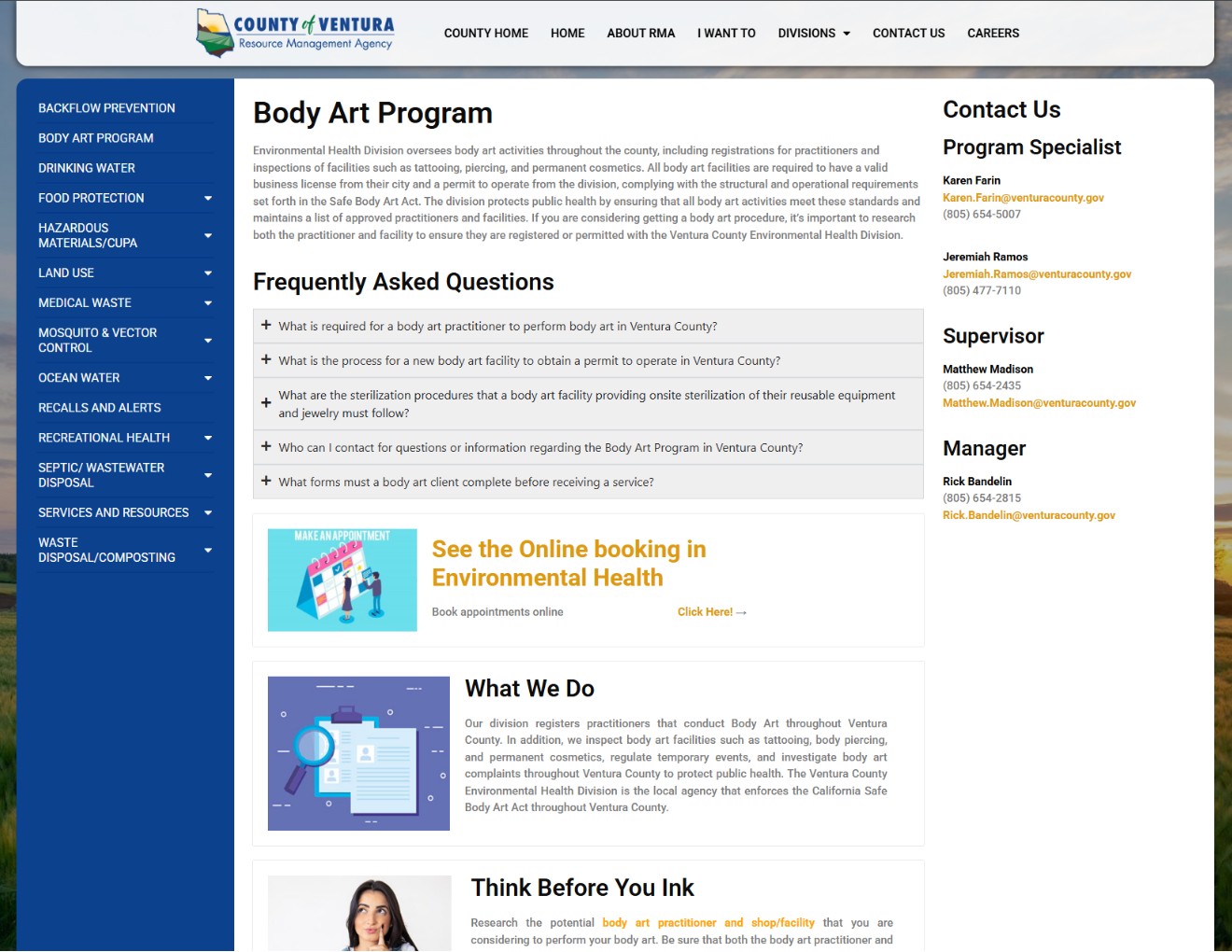
Ventura’s website stood out. I found its body-art program pages especially thorough, thoughtfully organized, and visually appealing. Yet one practical question remained difficult to answer: Where could I find the practitioner list?
The staff member who assisted me was kind and helpful, directing me toward the relevant information. Even with that guidance, I still had to hunt through the page to locate the link buried within the text.
It was a small experience, but it raised a larger question. If someone actively researching practitioner oversight struggles to locate a list, how easily can a consumer find and understand that information before booking a procedure?
Across my research, a common thread has emerged: jurisdictions vary considerably in how they present their body-art programs. The information available, the language used, and the route to finding a practitioner or establishment record can differ from one county to another.
This observation extends our earlier discussion about permanent-makeup standards. Public protection depends on both the requirements a jurisdiction establishes and how clearly it communicates what those requirements mean.
Finding a name is only the beginning
A public list can answer an important question: Is this person or establishment recorded by the responsible agency?
But the reader also needs to understand what inclusion establishes.
Does the record identify an individual practitioner or a permitted facility? Does it confirm current registration, bloodborne-pathogen training, a licensing examination, or some other requirement? Does it identify the procedures the practitioner is authorized to perform?
These distinctions matter because a consumer may interpret an official listing as a broader endorsement of skill than the underlying program actually provides.
A record is most useful when the public can find it, understand what it verifies, and recognize the limits of that verification.
From public access to practitioner competence
That brings us back to the question raised in our Virginia and Oklahoma coverage: What evidence should qualify someone to perform permanent makeup?
Our earlier reporting examined different licensing pathways and examinations in those states. The continuing issue is the substance behind each requirement: what education is verified, what knowledge is tested, whether practical performance is assessed, and who makes the final determination.
Larimer County’s proposed body-art program brings another dimension into view. A common public-health examination can establish knowledge of sanitation, bloodborne pathogens, and regulatory responsibilities. A PMU-specific assessment would need to address additional competencies, such as skin assessment, design judgment, pigment selection, procedure technique, and evaluation of healed results.
Those assessments serve complementary purposes. Their meaning should be equally clear to the public.
The same clarity should apply to certification
Private certification introduces another layer of information for consumers to interpret.
A title such as “board-certified artist” should lead to an accessible explanation of the issuing organization, eligibility requirements, assessment methods, scope, and renewal obligations. Where an organization offers multiple credential levels, the differences should be understandable without requiring the reader to assemble requirements from several pages.
For Permanent Glow’s proposed certifying-body model, that means making the evidence behind a credential visible: published standards, verified experience, appropriate written and practical assessment, independent certification decisions, and clear renewal and appeal procedures.
A school completion certificate, a private competency credential, and government authorization each communicate something different. Their public descriptions should make those differences apparent.
A broader standard for public protection
My Ventura County experience began with a straightforward records request. It left me thinking about a broader opportunity: more consistent public communication across the jurisdictions responsible for body-art oversight.
A useful starting point would be a clearly labeled practitioner lookup, a separate establishment lookup, an explanation of each record’s meaning, and an obvious route for questions or complaints.
Ventura’s thoughtful presentation and helpful staff made the remaining navigation difficulty particularly noticeable. The experience showed how even a well-developed website can benefit from making its most important public records easier to locate.
As the PMU industry considers stronger standards for licensure and certification, it should also consider the public’s ability to use them.
The standard should extend from what a practitioner must prove to how clearly a consumer can verify it.
