
What Virginia, Oklahoma, and ISO Tell Us About PMU Competence
States are testing different approaches to permanent makeup oversight. The larger public-protection question is whether completing training is enough—or whether a practitioner should also have to demonstrate competence before working independently.
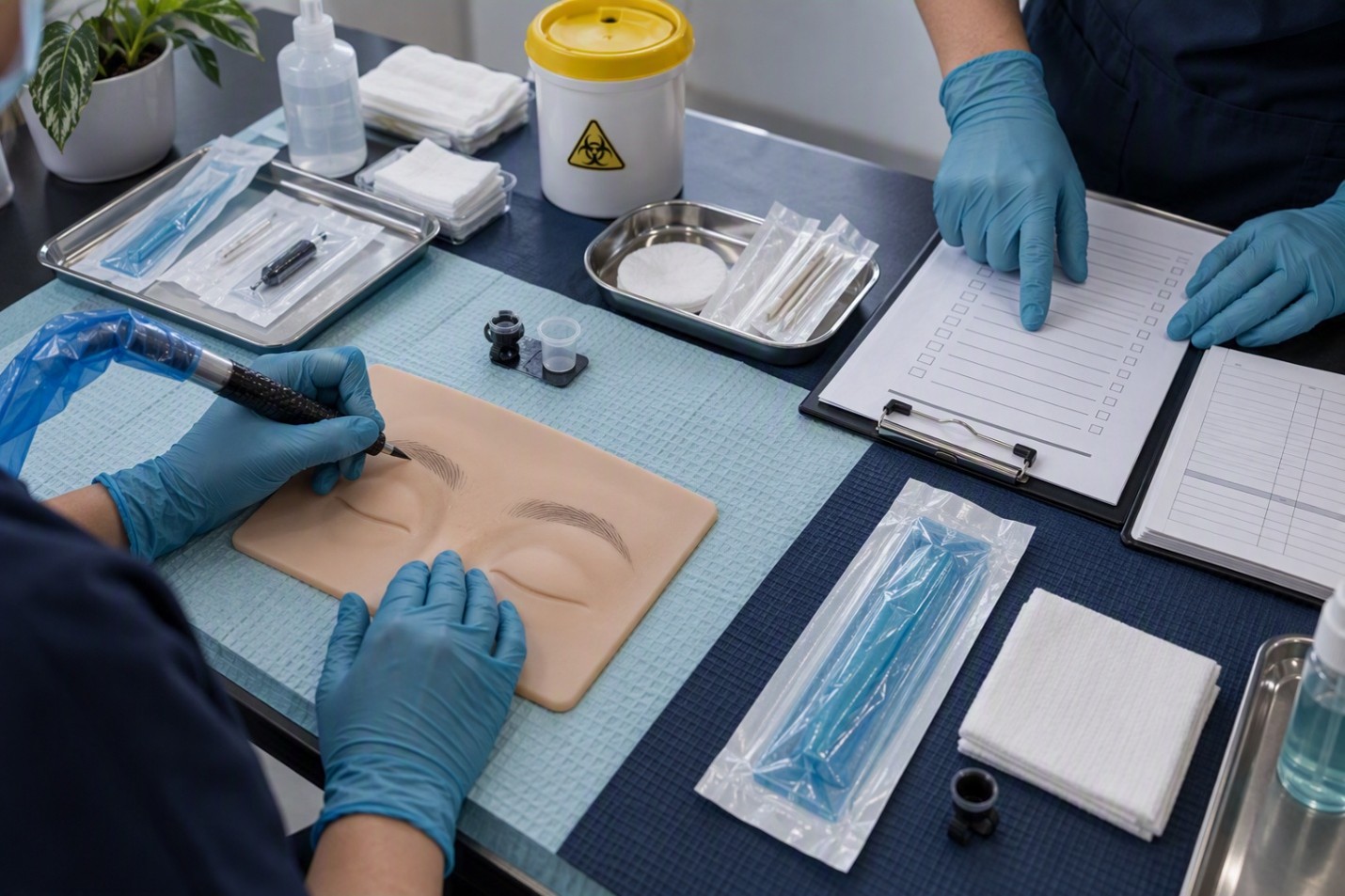
Supervised permanent-makeup training can develop technique and judgment, but course completion alone does not establish independent competence or legal authority to practice.
Permanent makeup sits at an unusual intersection of personal services, tattooing, aesthetics, and—in some jurisdictions—medical practice. That makes regulation inconsistent from one state to another. It also creates a persistent industry problem: the word certified is often used for several very different forms of recognition.
A school may issue a certificate showing that a student completed its course. A state may issue a license or registration authorizing a person to work legally. An independent certification body may assess whether a person has demonstrated defined competence. Those documents may all be legitimate, but they do not answer the same question.
For clients, regulators, schools, and practitioners, the central question is straightforward:
What evidence should be required before a person is considered ready to perform permanent makeup independently on the public?
Recent developments in Virginia and Oklahoma illustrate why the answer should not rest on a course-completion certificate alone. The newly published ISO/IEC 17024:2026 standard also provides a useful framework for thinking about independent personnel certification—without replacing state or local legal authority.
Four forms of assurance that should not be confused
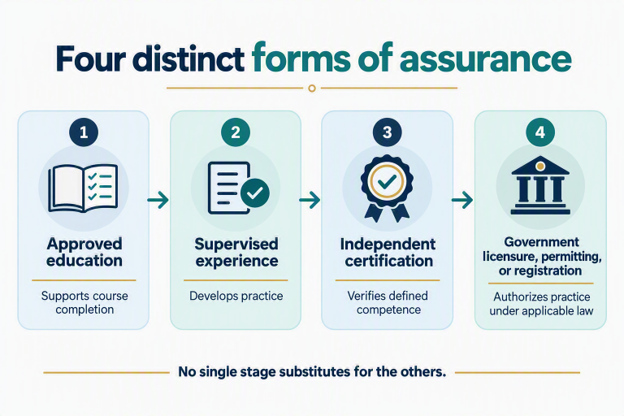
An effective regulatory or credentialing system begins by separating four functions:
School or program approval
Establishes: The provider meets requirements for curriculum, instructors, records, facilities, and operations.
Does not necessarily establish: Every graduate can practice safely and competently without supervision.
Course-completion certificate
Establishes: The student completed specified training.
Does not necessarily establish: Practical competence has been independently verified.
Personnel certification
Establishes: The individual met the requirements of a defined certification scheme, typically through independent assessment.
Does not necessarily establish: Legal authorization to practice in a particular jurisdiction.
License, permit, or registration
Establishes: A government authority permits practice under applicable law.
Does not necessarily establish: Every jurisdiction uses the same depth of competency assessment.
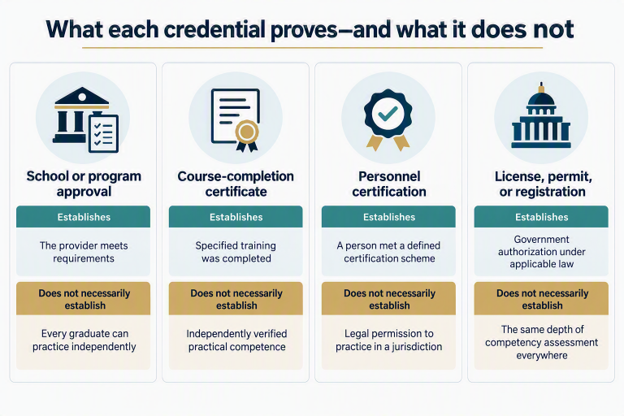
This distinction is not an argument against schools. Strong schools are indispensable. It is an argument for accurately describing what each part of the system can prove.
A training provider is responsible for education. A certification body is responsible for an impartial decision about competence. A government agency determines whether—and under what conditions—a person may practice legally. In a mature system, those functions reinforce one another without being treated as interchangeable.
Virginia: a specialty-license proposal stalled, while school oversight is moving
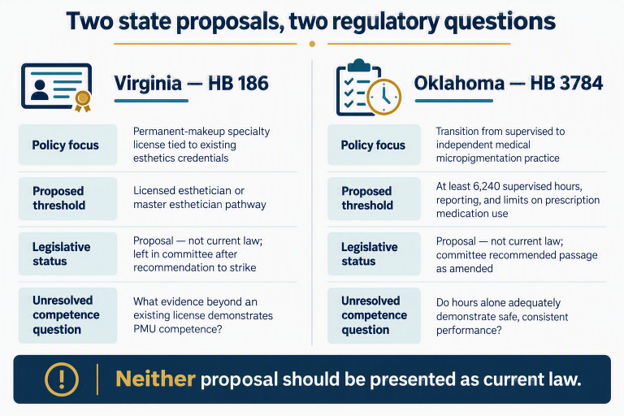
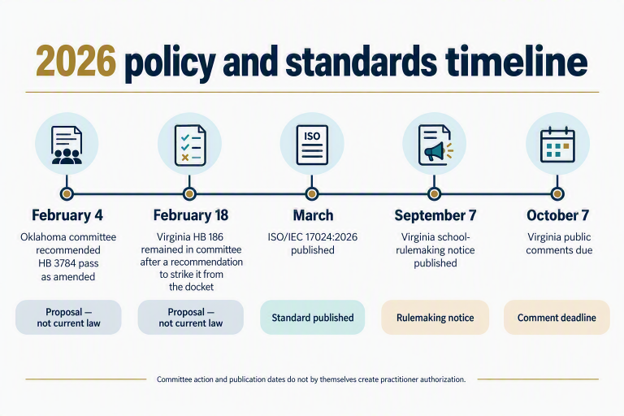
Virginia considered House Bill 186 during the 2026 regular session. The proposal would have authorized the Board for Barbers and Cosmetology to issue a permanent-makeup specialty license to licensed estheticians and master estheticians. It also contemplated licensure by endorsement for certain practitioners licensed elsewhere. The measure did not advance: a subcommittee recommended striking it from the docket, and it was left in the House General Laws Committee on February 18.
HB 186 is still instructive. It attempted to create a distinct government credential for permanent makeup, but it located eligibility within the existing esthetics professions. That raises policy questions that are likely to recur in other states: Should permanent makeup be a specialty within esthetics, a branch of tattooing, or a separate occupation? Should entry depend on holding another professional license? What evidence, beyond status as an esthetician, demonstrates competence in implanting pigment?
Virginia also opened a broader rulemaking process in September. The Board for Barbers and Cosmetology announced that it intends to amend regulations governing barbering and cosmetology, tattooing, body piercing, and esthetics. The principal mandate is to create licensure and operating rules for body-piercing and ear-piercing schools, including instructor qualifications and curricula. The notice also says the board may revise existing school rules involving inspections, student transfers, and the addition of training programs. Public comments are due October 7, 2026.
This notice does not create a new PMU credential, and it should not be reported as one. Its significance is structural: Virginia is actively examining how schools are licensed, inspected, staffed, and permitted to add programs across related regulated fields. That creates a timely opportunity for stakeholders to advocate for clear distinctions among school approval, student completion, and independent practitioner competence.
Why Virginia matters
Virginia shows both the appeal and the limitations of a license built around prior professional status. A specialty license can establish legal accountability, but its public value depends on the requirements beneath it. If future proposals return, policymakers will need to decide whether prerequisites, training hours, supervised procedures, written knowledge, practical performance, and continuing competence are all addressed—and by whom.
Oklahoma: extensive supervised experience as a threshold for independence
Oklahoma House Bill 3784 took a different approach. The 2026 proposal concerned medical micropigmentation and the point at which a certified individual could work without physician supervision.
The policy committee substitute would have allowed physician supervision to end after a practitioner completed at least 6,240 supervised hours, reported those hours to the State Board of Health, and refrained from using prescription medication on clients while performing the service. The House Public Health Committee recommended that the measure pass as amended on February 4. The official legislative history available as of this article’s publication shows no later action.
The proposal therefore should not be described as current law. It is nevertheless important because it recognizes a principle that is often missing from entry-level PMU discussions: training completion and readiness for independent practice are not necessarily the same milestone.
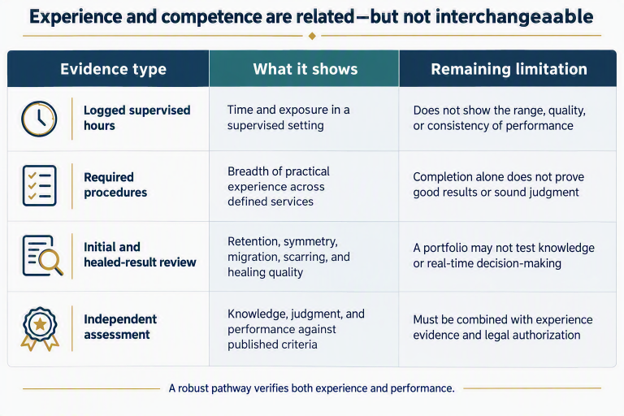
At the same time, hours alone are an incomplete proxy for competence. Two people can spend the same number of hours in practice and emerge with different levels of skill, judgment, documentation, infection-control discipline, and ability to manage complications. A robust pathway should verify both experience and performance.
Why Oklahoma matters
Oklahoma’s proposal offers a useful contrast with Virginia. Virginia’s bill focused on a specialty license connected to an existing occupation. Oklahoma’s proposal focused on the conditions for moving from supervised to independent practice. Together, they point toward a more complete model: defined education, meaningful supervised experience, an impartial demonstration of competence, and government authorization appropriate to the jurisdiction.
Where ISO/IEC 17024:2026 fits—and where it does not
ISO/IEC 17024:2026, published in March 2026, is the current international standard for organizations that certify people. According to ISO, certification of persons provides assurance that an individual meets defined competence requirements within a specific certification scheme. The standard establishes requirements intended to help certification bodies operate consistently and reliably.
That makes ISO/IEC 17024 relevant to a future PMU personnel-certification system—but it is important to use precise language.
● ISO does not license PMU practitioners.
● ISO/IEC 17024 is not a curriculum for permanent makeup.
● It does not make a school certificate equivalent to an independent competency credential.
● It does not, by itself, authorize anyone to practice under state or local law.
● A certification body may seek accreditation to ISO/IEC 17024; individual practitioners would be certified under that body’s defined scheme.
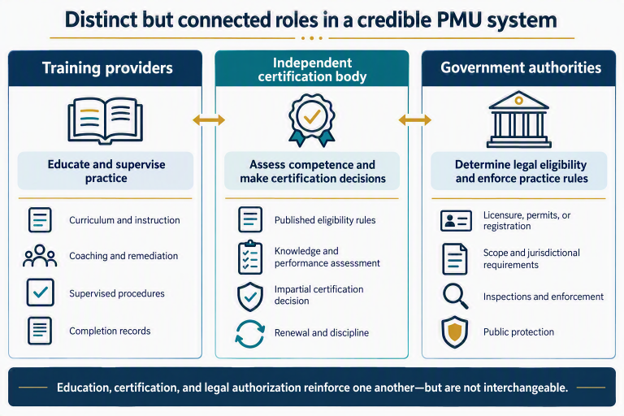
The standard applies to the organization making certification decisions about people. Schools would occupy a different role. They could be recognized or approved as training providers if they meet published requirements, but course completion would remain evidence of education—not the final certification decision.
This separation protects both learners and reputable schools. A school can concentrate on instruction, coaching, supervised practice, and remediation. An independent certification process can apply the same eligibility rules and assessment standard to candidates from multiple approved pathways. The result is a credential whose meaning does not depend solely on the school that issued the student’s completion document.
What a credible PMU pathway could measure
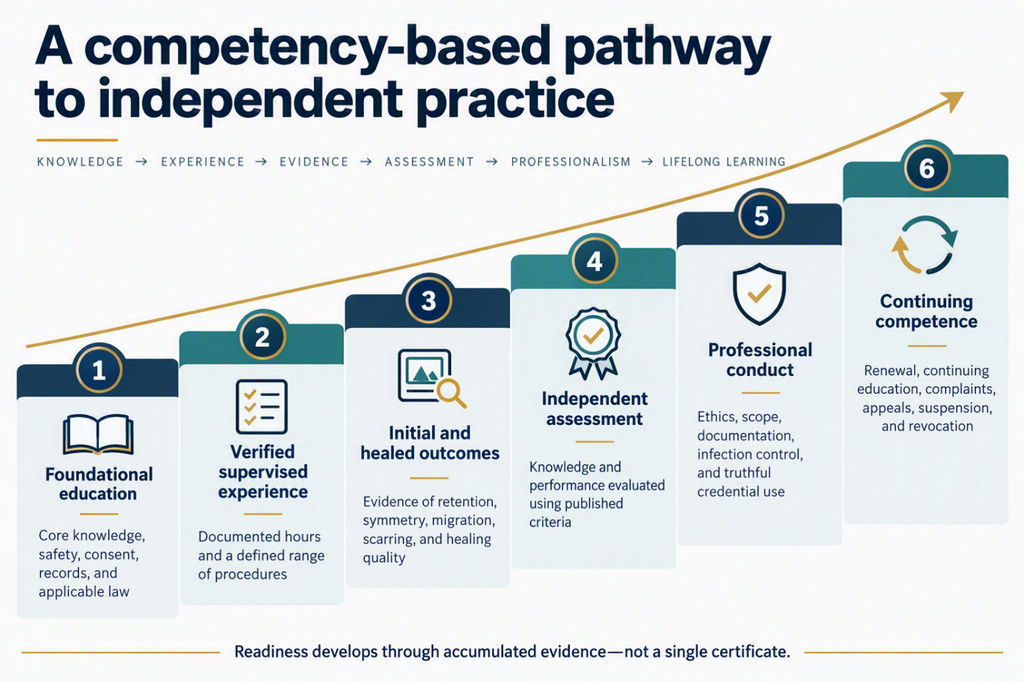
State law will continue to determine who may practice. Within that legal framework, a competency-based model could require evidence in several stages:
1. Foundational education. Documented instruction in anatomy and skin, bloodborne pathogens, infection prevention, contraindications, color theory, equipment, pigments, consent, records, aftercare, complications, and applicable law.
2. Supervised experience. Verified hours and a defined number and range of procedures—not hours alone—with qualified supervision and reliable records.
3. Outcome evidence. Review of initial and healed results, because immediate appearance does not reveal retention, migration, scarring, symmetry, or healing quality.
4. Independent assessment. A written examination for knowledge and a practical or performance-based examination using published criteria and qualified assessors.
5. Professional conduct. Requirements for ethics, scope of practice, informed consent, client documentation, infection-control compliance, and truthful use of credentials.
6. Continuing competence. Time-limited certification, renewal requirements, continuing education, and a process for complaints, appeals, suspension, and revocation.
Under this model, schools would not be dismissed or displaced. They would be evaluated against transparent training-provider criteria: curriculum alignment, instructor qualifications, facilities and infection-control practices, supervised-procedure rules, student records, completion standards, audit rights, and truthful advertising. Their graduates would then demonstrate competence through an assessment process that is independent of the school’s commercial interest in graduation.
The policy question is not “school or certification?”
The better question is how education, experience, assessment, and legal oversight should connect.
A course certificate can truthfully show that training occurred. It becomes misleading only when it is presented as proof of abilities that were never independently assessed. Likewise, a license can create legal accountability without necessarily establishing a nationally comparable competence standard. Independent certification can add consistency and portability, but it cannot override state or local practice laws.
For policymakers and industry leaders, the most useful design questions are therefore:
● Is the required training tied to a defensible analysis of actual PMU practice?
● Are minimum hours supplemented by required procedures and observable outcomes?
● Is competence assessed by qualified people who are impartial in the certification decision?
● Can applicants from different legitimate training pathways qualify under the same rules?
● Are schools evaluated consistently without being allowed to certify their own graduates as independently competent?
● Are the credential’s limits explained clearly to practitioners, clients, insurers, and regulators?
● Is there a path for renewal, complaints, discipline, and public verification?
© 2026 Permanent Glow. All rights reserved. This publication may be quoted in limited excerpts with clear attribution. Reproduction, republication, commercial adaptation, distribution, or use in developing a competing commercial program without written permission is prohibited.
