Following our earlier coverage of Virginia and Oklahoma, these states illustrate an important distinction: completing training, demonstrating competence, and receiving legal authority to practice are separate achievements. A credible credential must explain which of these it represents.
Virginia: A structured practitioner-licensing model
Virginia’s HB 186 proposed a permanent-makeup specialty pathway for licensed estheticians and master estheticians. It did not become law, leaving the existing permanent-cosmetic-tattoo licensing framework in place. The bill’s outcome does not, by itself, establish lawmakers’ reasons for declining the proposal.
The more consequential development is Virginia’s updated tattooing regulations, effective January 5, 2026. They maintain separate permanent cosmetic tattooer and master permanent cosmetic tattooer licenses, along with school licensing, instructor certification, approved curricula, examinations, and separate salon credentials. This framework addresses both practitioner qualifications and practice conditions.
The current minimums include:
| Virginia training program | Minimum instruction | Required performances |
| Permanent cosmetic tattooing | 200 hours | 60 |
| Master permanent cosmetic tattooing | 200 hours | 55 |
These are distinct program requirements; the master program should not be presented as an interchangeable entry-level route.
Schools also had to submit updated curriculum packages by April 1, 2026, and obtain Board approval before offering the revised programs. School authorization and curriculum approval therefore form part of the credential’s supporting structure.
Oklahoma: Certification within a medical-supervision model
Oklahoma demonstrates why the word “certified” requires context. Its medical-micropigmentation framework requires state-approved training and testing, while retaining physician-office and supervision requirements for nonphysician practitioners. State certification does not automatically confer independent practice authority.
HB 3784 proposed allowing supervision to cease after at least 6,240 supervised hours had been reported to the State Board of Health. The bill received a favorable Public Health committee recommendation in February but did not advance into law. That proposed threshold is legislative-history evidence, rather than an enacted requirement or a validated national measure of competence. The record also does not establish why the proposal stalled.
Oklahoma continues to provide a state-authorized medical-micropigmentation certification examination through Career-Tech. Candidates must present Health Department authorization; the published testing fee is $200.
What this means for certification legitimacy
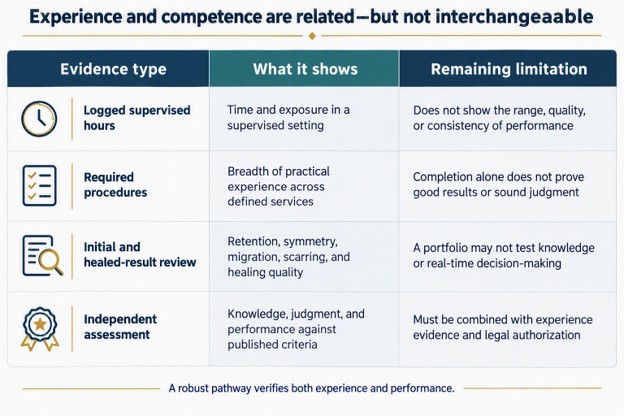
For consumers, policymakers, and practitioners, the useful question is: What evidence stands behind the certificate?
A defensible PMU competency credential should identify:
- Scope: The procedures and level of practice it covers.
- Education: The curriculum, prerequisites, and verified training.
- Assessment: How knowledge, practical skill, and professional judgment are evaluated.
- Experience: Documented procedures, supervision, and assessment of healed results.
- Accountability: Credential verification, complaints, renewal, and disciplinary processes.
These are recommended design principles for a certification system, rather than a claim that both states currently require every element.
© 2026 Permanent Glow. All rights reserved. This publication may be quoted in limited excerpts with clear attribution. Reproduction, republication, commercial adaptation, distribution, or use in developing a competing commercial program without written permission is prohibited.